
Trumbull County Crime News Sources
Start with the Sheriff's weekly blotter. It logs incidents and events handled by law enforcement across the county, and each entry can carry a calls-for-service number, the date and time a call came in, a location, the type of activity, the city, and how the call was closed. What it does not do is track jail bookings. An entry on the blotter tells you something happened, not who ended up in custody or what a court later did with the matter.
Custody questions call for a different tool. The Sheriff's PublicView roster splits current jail records from historic ones, and it can show a booking image when the agency has one on file. Keep the two systems straight in your head. Someone named in a blotter entry may have been released, moved to another facility, or never booked at all. City police also write their own reports, and those stay with the city.
For news coverage, the Tribune Chronicle police-blotter index is the most reliable local source covering county agencies and the three map cities. It's a text product, not a photo gallery. The paper posts blotter items in batches, so a publication date tells you when the batch ran, not when an arrest or booking actually happened.
Note: Use the weekly blotter for incident context, PublicView for custody, and court records for case files.
Trumbull County Outlet Record Paths
Newsrooms and public agencies produce very different material. Knowing which is which saves time. The table below breaks down what each source offers and where to go next. One caution on images: don't assume a picture is a booking photo unless the article says so. Private county pages come last on the list for a reason. They can lag behind, miss details, or trail off before a case moves through the courts.
| Outlet or source | Coverage | Images | Best record path |
|---|---|---|---|
| Sheriff weekly blotter | Official weekly incident and event context. | No booking-photo function. | Sheriff records for a report, then the proper court docket. |
| Tribune Chronicle | Recurring police-blotter reports across Warren, Niles, Girard, and other jurisdictions. | Textual section, not a dedicated gallery. | Identify the agency and verify the matching official record. |
| 21 WFMJ | Frequent case-specific local reporting, including arrests and court matters. | Images vary by story. | Use article details to find the Sheriff or court record. |
| The Vindicator | Regional police-blotter reporting, mainly Mahoning-area material. | Textual reporting. | Use only as nearby context, not as a Trumbull-wide booking source. |
| Private county landing pages | Historical or searchable publisher material that can contain county references. | May display publisher-supplied record images. | Confirm every item with the Sheriff, agency, or court of record. |
A newsroom listing is not an official report, either. A blotter item may describe a warrant service, a transport, or a routine call without anyone ever being booked into the jail. The same limit applies in the other direction. A current roster hit tells you someone is in custody, not where the case stands down the line.
Trumbull County News Images and Booking Photos
Ohio's public-records rules let you ask an agency for what it holds, within some exemptions and redactions. That right has limits in practice. Not every department sends booking photos with each press release. Newsrooms pull images from all over. A story might carry a scene photo, an agency handout, a courthouse picture, or stock art. The Sheriff's live PublicView system stands apart. It's the only official county interface that displays a booking photo when one exists.
Match the request to the story. If an article names a city agency, ask it for the incident report. If it involves the county jail, check the Sheriff roster. If a case has been filed, follow the docket. One last tip: the photo and the record often come from different places. Don't blend them in a caption or summary.
Ohio Revised Code 149.43 sets the rules for public-record access, along with its exceptions. If you need a record, send a focused request to the agency that holds it and include any details you have, such as a report number, date, location, or case number.
Trumbull County Story to Record
Treat a news report as a lead, not a conclusion. Pull the details the story actually gives you. Then follow the record path that matches the stage of the matter. The county keeps its systems separate on purpose. Jail bookings run through PublicView. The Clerk keeps filed pleadings and dockets. Central District Court posts its own warning that online data can lag behind what's on file at the courthouse.
- Read the story for the agency, approximate date, place, court name, case number, or report number. Do not infer missing facts from an image or headline.
- For a possible county booking, search official PublicView with the narrowest stable identifiers. Select current or historic status according to the question and note any displayed case number.
- For the incident report, contact the agency named in the reporting. The Sheriff holds county incident records, while a city police department may hold the first report it created.
- Use the Common Pleas public search for a relevant felony filing, or Central District CaseLook for matters in that court. Follow the docket beyond the first charge.
- Verify Central District information with the clerk when it matters. Its online records can lag at least 24 hours or longer, and the court says warrant information requires clerk verification before official action.
Want more depth? The county-wide booking, roster, and records path spells out the official custody and request routes in full. A city mention in a story helps you spot the arresting agency. Just remember that a city news item alone doesn't mean the person ever saw the inside of the county jail.
Trumbull County Booking and Court Stages
PublicView booking records carry the details that matter early on. Expect a booking date, the charge description, bond figures when the jail supplies them, and a court date with the court name and case number. The Common Pleas Clerk takes over from there, filing and preserving the pleadings for felony cases. Central District Court keeps its own set of records. A booking card, though, only shows one stage. Media stories do too. The docket comes later, and it tells a fuller story.
Here is how a case typically moves. An incident gets reported. Booking happens if the county takes custody. The case is routed to a court, docket entries pile up, and a disposition eventually closes it. A release date or a name dropping off the current custody list settles nothing about the charge itself. The Central District site also warns that its updates lag, so clerk verification beats trusting any online result as final.
Need a straight answer from a human? The Criminal Clerk line is 330-675-3056. Staff-run searches and court copies carry published fees, and public computers let you search Common Pleas and Domestic Relations files yourself.
Note: A case number connects a booking entry or news story to the court docket, but the clerk stays the verification point for anything time-sensitive.
Trumbull County Private Publisher Limits
Private county landing pages show up once you move past the official sources. Treat them as background. Each publisher collects material its own way, on its own schedule, with its own corrections process and editorial judgment. An entry there can be stale, thin, or simply out of step with what a court later did. Nothing on those pages substitutes for current Sheriff custody information or a filed court record.
The RecentlyBooked Trumbull County landing page is one such archive, searchable and county-specific. Its refresh and sourcing statements belong to the publisher alone. They are claims, not verification of any booking or status.
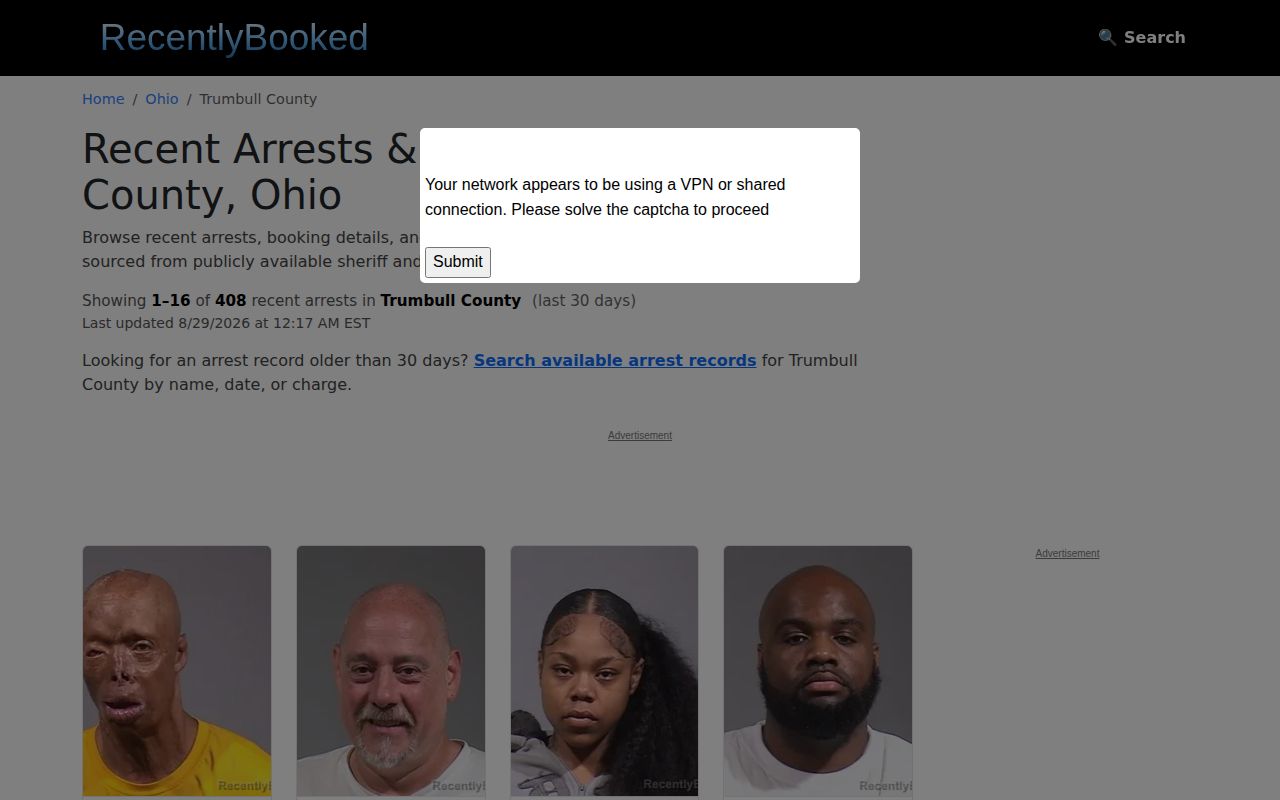
A screenshot of that county landing page stands as an example of a private source. It authenticates nothing. It establishes no one's custody.
The Mugshots.com Trumbull County section is a private historical hub, and its own publisher disclaims accuracy and timeliness. Reading it as a current booking feed would be a mistake.
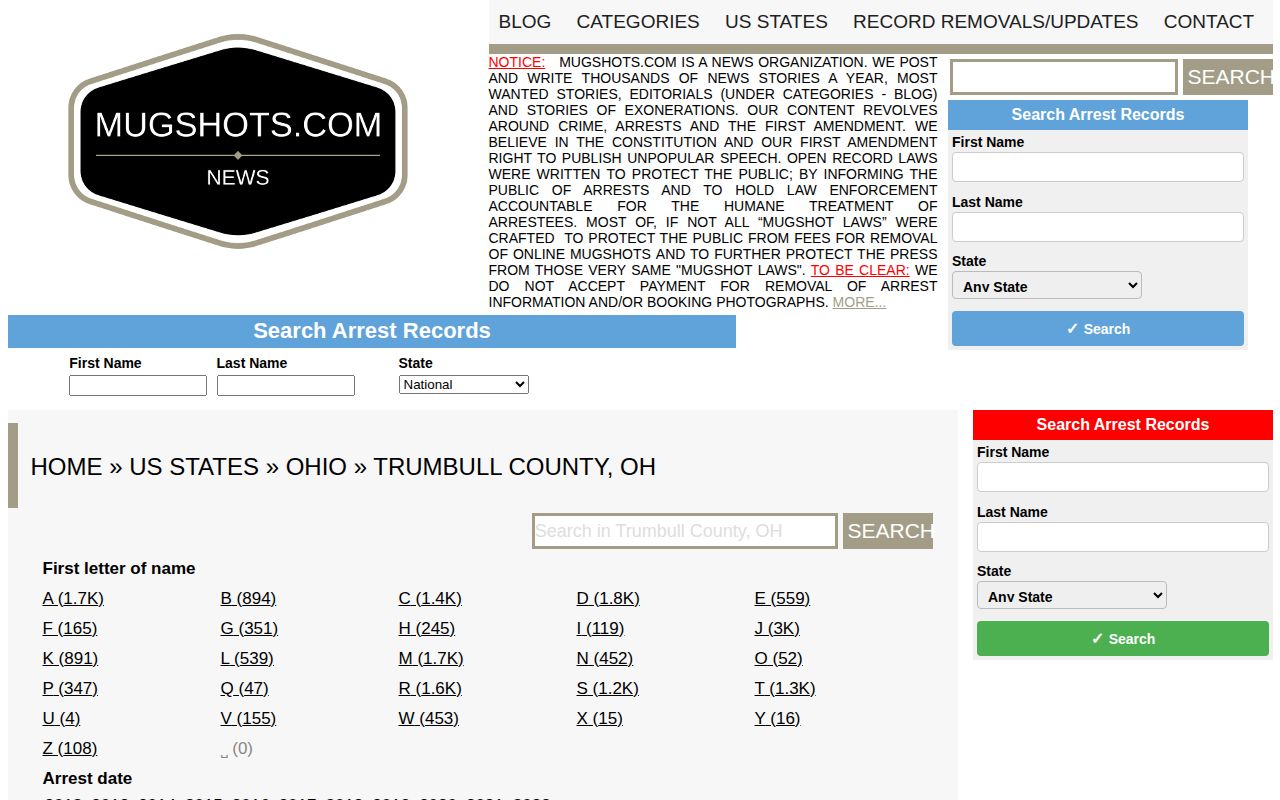
Historical collections like these are exactly why an official roster and a court docket should anchor any status check. Everything else trails behind.
The private Mugshots.zone Trumbull County page carries county-oriented material that can go stale without warning. Its own disclaimer tells readers to go to the originating law enforcement agency for current information. That's sound advice.
Treat that landing-page capture as a glimpse of the local publishing landscape. It says nothing about any person or case.
BustedNewspaper and Arrests.org run private county sections of their own. Neither is official. Neither counts as a Trumbull County roster or court record. They cannot tell you if someone sits in custody or how a case resolved. Treat them as leads, not answers.
Trumbull County Local News Context
For recurring police-blotter context, the Tribune Chronicle is the local standby. Its police-blotter section is the source shown in the image below. Coverage stretches across Warren, Niles, Girard, and other jurisdictions through agency-specific reports. Remember what it is, though. It is newsroom reporting, not a records custodian.
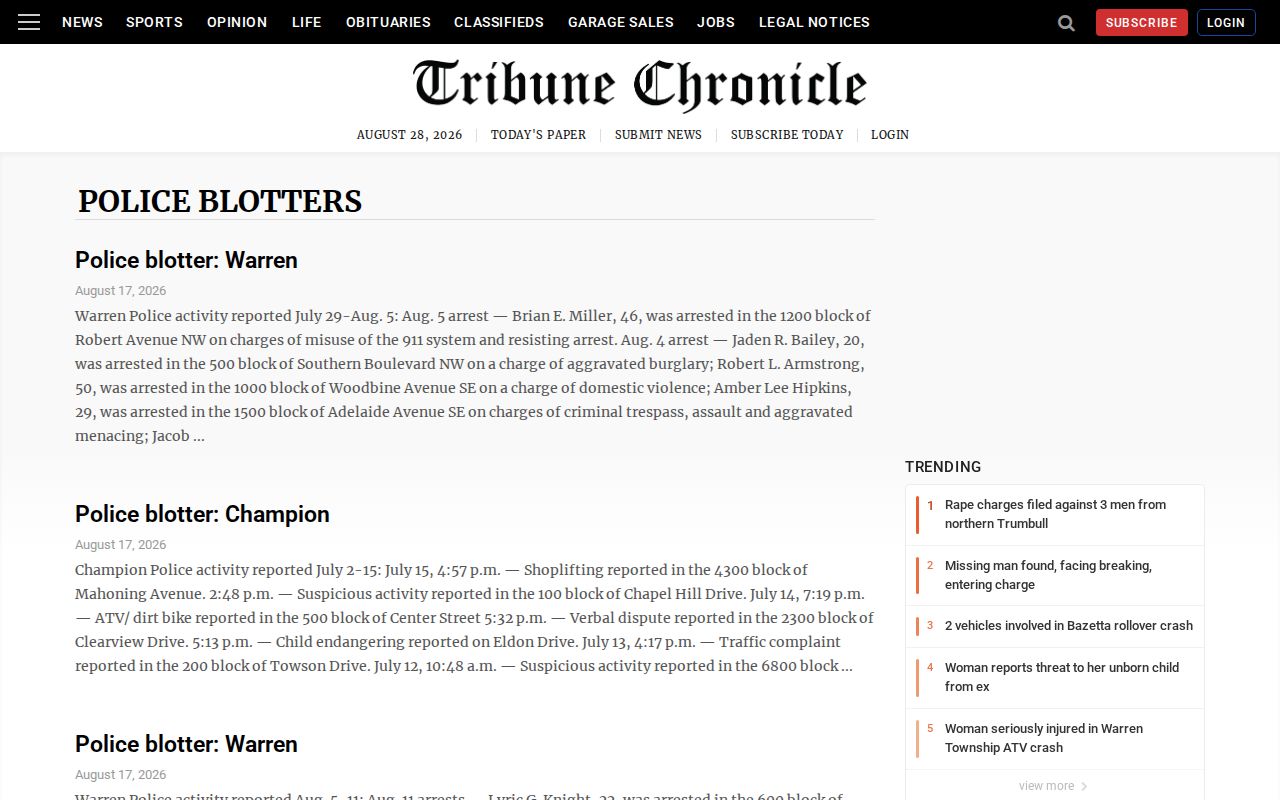
A blotter index helps you spot a reporting batch or a single agency. That is its limit. Confirming a booking, release status, or outcome still takes the matching official record.
21 WFMJ local news offers case-specific coverage when an event draws attention. The Vindicator police blotter leans regional and Mahoning-heavy. It is not a countywide Trumbull booking source. For city-level agency context, the Warren Busted Mugshots record route points to the local police path. News coverage is not an official arrest log, and it should not pose as one.